Fiberglass post in dentistry

Often times the reconstruction of a tooth is a very difficult task to achieve if you do not have the support of a healthy dental tissue. What does that mean? When the destruction of a tooth is very large due to dental decay or to a fracture and there is nothing left but a few and very thin crown walls along with the root, we can not make a really stable and strong direct reconstruction .We need increased retention to obtin an enhanced resistance. For this reason, there is  the solution of inserting posts in the root canal space.

(first picture - old incorrect root canal treatment, cavity, bone infection and metal pin)
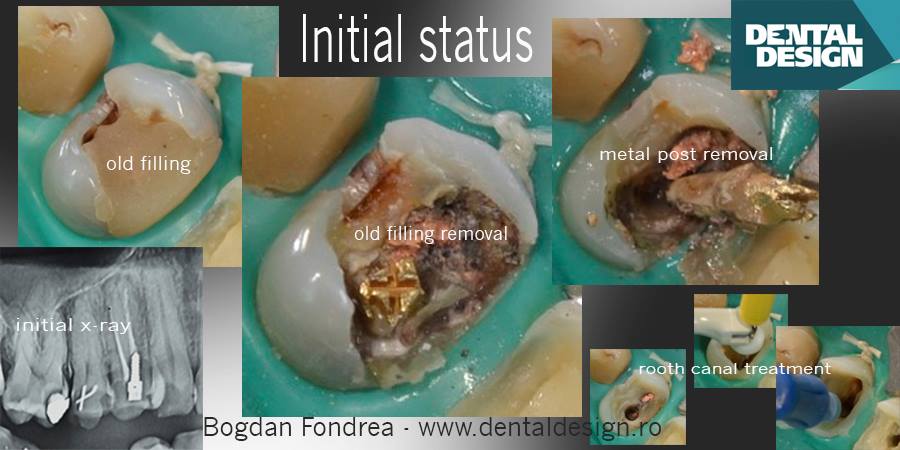
pivot dinte metalic

Initially, these posts ( called crown-root devices or pins) were metallic and sometimes they were prefabricated and inserted directly. Sometimes they were custom-made in a dental laboratory by a dental technician from a dental impression. Unfortunately, they had a lot of disadvantages like the considerable amount of coronal and radicular sound tooth structure that was sacrificed with increasing risk of root perforation and fracture.

Improvements in composites and the development of dentine bonding systems have simulated a trend toward more conservative techniques of tooth restauration and so it began the use of the fiberglass posts system.

(second picture - new root canal treatment, no cavity, two fiberglass post core build up)
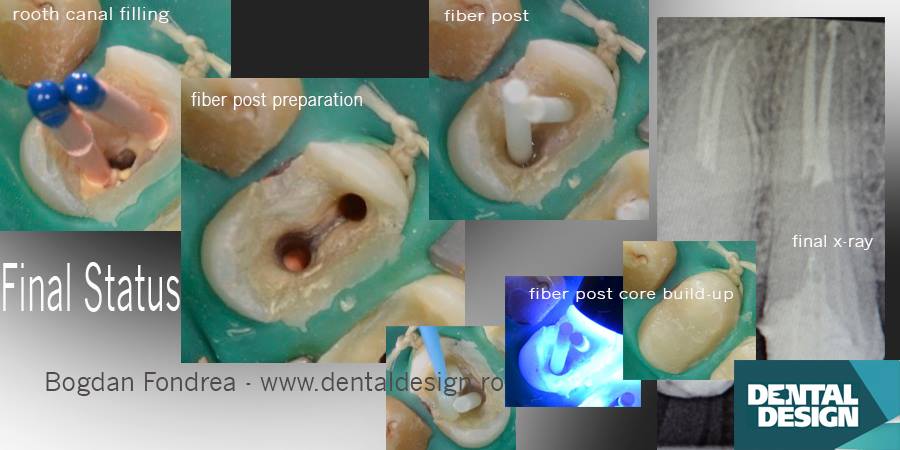
pivot fibra de sticla

The similarity in the modulus of elasticity of fiberglass posts and resin cement with that of dentine have been advantageous in improving the performance of these kinds of restorations, compared with cast metal post and core restorations.

It is thought that fiber posts can distribute stresses between the post and dentine by their flexibility under load, resulting in favorable clinical behavior. Thus, if excessive forces are applied to the tooth, the post will be able to absorb them, reducing the possibility of root fracture.

Currently used fiberglass post systems are designed to be corrosion resistant, able to bond to tooth structure, esthetically pleasing, and to allow retrieval when the post core system fails.

Fiberglass is a biocompatible, inert, translucent, and durable material that includes free radicals that can form chemical connections.

They are easy-to-use, reliable, and cost-effective with a scientifically documented background. The time of work is reduced and the fiberglass post can be inserted in the  same session with the root canal treatment. The tooth preparation is minimum (very low dental sacrifice) because the fiber post has only 1,2 - 1,50 mm diameter.

There are no allergic reactions to them and they are easily accepted by any pacient because no one likes to have something metallic in their mouth.

Stay strong, stay flexible! 🙂

Bogdan Fondrea & Denisa Sava - www.dentaldesign.ro

Bleaching of a Non-Vital Tooth

Non-vital teeth with incorrect root canal treatment can, and often do, change their color as time passes. Some of them can change their color in grey, pink, brown or other shades. This is due to the deposition of degraded blood left from the incomplete pulp removal, or sometimes the root canal filling materials used as a part of the "old school''.

Regardless of the cause, the discoloration of the tooth can, and should be corrected. To begin with, we must find out the reason of this discoloration. If the root canal treatment it is not correct (read -how to see when a root canal treatment is correct), then it must be redone. In fact, this is the main reason of all discolorations, an incorrect root canal treatment, with a still infected root canal.

albire dinte fara nerv

Bleaching a root canal or an endodontically (endo = inside, dont = tooth) treated tooth involves placement of a bleaching agent into the empty pulp chamber of the non-vital, discolored tooth. Today the most common and safest internal bleaching agent used for this technique is sodium perborate. Sodium perborate is a hydrogen peroxide releasing agent that when mixed with hydrogen peroxide, it accelerates the rate of color change. This bleaching agent can be left inside the empty pulp chamber for a few hours or days.

Non-vital tooth bleaching is performed only after a repeated and correct root canal treatment (the procedure is described here). Then, we increase the tooth strength by inserting a fiber post and the access cavity is restored with composite resin.

If the tooth presents large composite restorations, a large discoloration and a change of shape and size then it may be advisable to do a restauration with a veneer or crown, but Be careful!, only after solving the medical problems described above, not instead of these.

Non-vital tooth bleaching starts with a correct root canal treatment!

Bogdan Fondrea & Denisa Sava - www.dentaldesignclinic.co.uk 

How to figure out when a root canal treatment is correct?

The root canal treatment is recommended when the nerve and the blood supply of the tooth (known as the pulp) is infected. In most cases this happens because of a deep decay or injury. Sometimes this treatment is necessary in order to prepare the tooth for a crown.

A root canal treatment is performed in one or two sessions. Sometimes there are infections at the root apex due to incorrect root canal treatment and that might require two sessions of treatment if the dentist can't clean and dry the canals properly in only one appointment. There are no poisons or other dangerous substances used in order to "kill the nerve", only correct irrigation with sodium hypochlorite, after a proper shaping and cleaning of the root canals. One thing you should know is that the root canal treatment will not hurt because a local anaesthetic is always used. Sometimes, after the completion of the treatment there may be some tenderness if pressure is applied for a few days or up to a week. This is no need for worries and this sensation should go away under pain control drugs that sometimes dentists prescribe.

tratament de canal

A correct root canal treatment contains 3 important aspects:

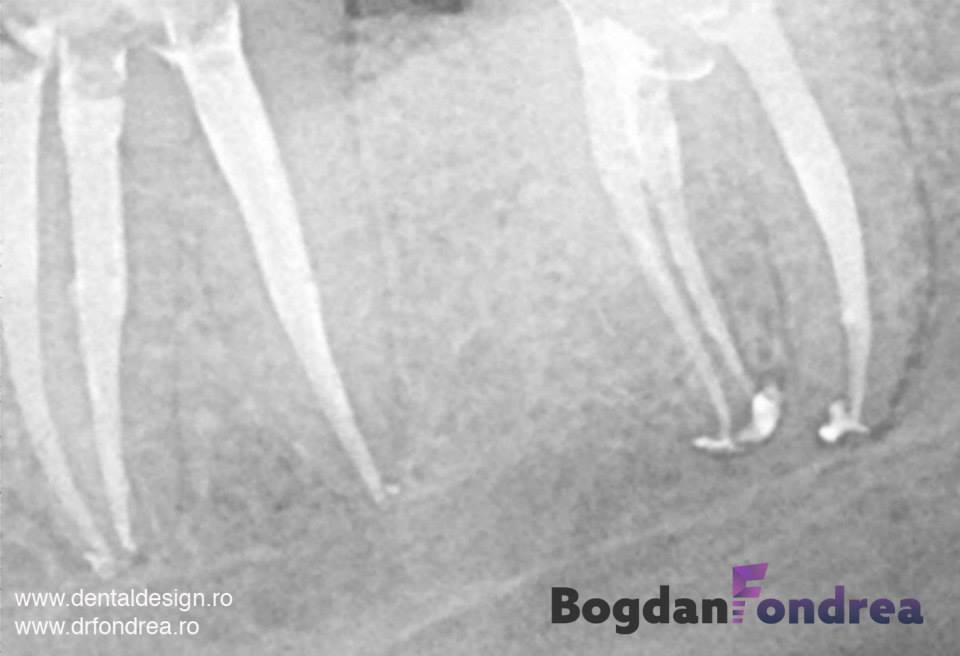
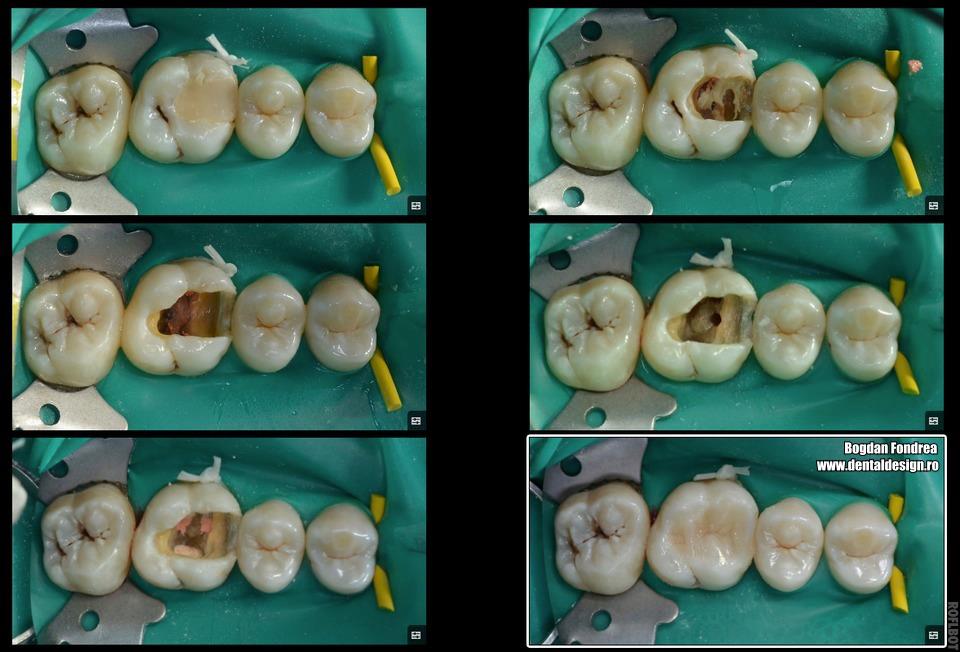
1. X-rays (radiographs)- one before the treatment and at least one more after the treatment. The before x-ray indicates on what situation the doctor begins to work on and what aproach to use for that specific situation. After the treatment the dentist can verify the work and have the certainty that the root canal treatment is done correctly (as seen in the first photo).

2. Rubber Dam (Dental Dam)- is the green membrane ( you can see it in the second photo) that is placed around the tooth in order to isolate it. The tooth must be isolated so all the chemicals that we use to irrigate the canals do not reach your tongue, or flow into your throat or inside your stomach. We also do not want your saliva to reach inside the tooth and contaminate it because the root canals must be disinfected and of course, saliva is not sterile.

3. Apex Locator- is an electronic device used to determine the position of the apex of the root when we reach it with a file through the tooth. This event is signaled with a beep, a flashing light or a pointer on a dial and thus we can also determine the length of the root canal, making sure that we do the treatment all the way until the end of the root, with a perfect precision.

root canal

It is quite easy to see x-ray the precision of the treatment on the check up x-ray. First of all, it is essential that the filling of the root canal with gutta-percha and adhesive cement (to ensure complete sealing) is all the way up to the apex of the root canal, not before it, nor passing over the apex. You can see in the picture a white line in the tooth, that is the gutta-percha cone. It is right at the very apex of the root. If it is not like this, the treatment must be repeated. Secondly, the white line in the tooth must be thick, compact and very visible as a result of a proper shaped root canal space.

If all these 3 aspects are fulfilled, we have all the chances to prevent the appearance of a infection inside the bone around the root apex or if this infection already exists, we can treat it. So, this way, in most cases we are preventing apicectomy (a sugical intervention at the root apex) that is unnecessary. Clearly, only these 3 points are not enough, but they are very important and they must not be omitted.

One should remember that in the vast majority of the cases (almost all of them) there are no antibiotics prescribed and the pulp of the tooth it is not killed with poisonous substances or other medication. The majority (if not all) of the treatments are made the way it is described above. The correct treatment is NOT done by antibiotics and poisons, but by cleaning, shaping and filling. Take care of your health and please stop using unnecessary drugs!

Every tooth is worth saving, but not every tooth can be saved! 

Bogdan Fondrea - www.dentaldesign.ro