How to figure out when a root canal treatment is correct?
The root canal treatment is recommended when the nerve and the blood supply of the tooth (known as the pulp) is infected. In most cases this happens because of a deep decay or injury. Sometimes this treatment is necessary in order to prepare the tooth for a crown.
A root canal treatment is performed in one or two sessions. Sometimes there are infections at the root apex due to incorrect root canal treatment and that might require two sessions of treatment if the dentist can't clean and dry the canals properly in only one appointment. There are no poisons or other dangerous substances used in order to "kill the nerve", only correct irrigation with sodium hypochlorite, after a proper shaping and cleaning of the root canals. One thing you should know is that the root canal treatment will not hurt because a local anaesthetic is always used. Sometimes, after the completion of the treatment there may be some tenderness if pressure is applied for a few days or up to a week. This is no need for worries and this sensation should go away under pain control drugs that sometimes dentists prescribe.
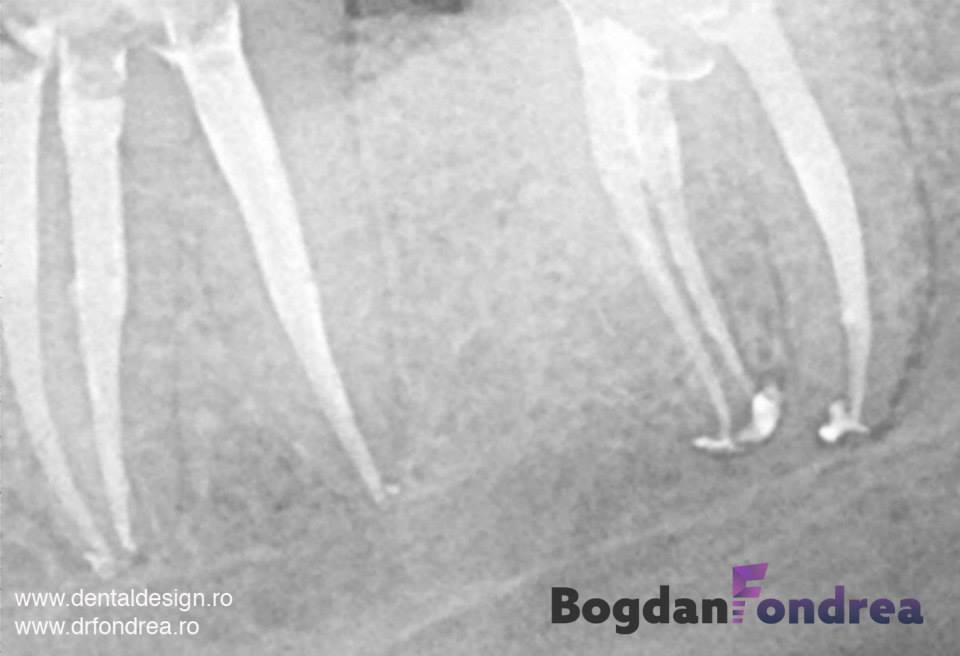
A correct root canal treatment contains 3 important aspects:
1. X-rays (radiographs)- one before the treatment and at least one more after the treatment. The before x-ray indicates on what situation the doctor begins to work on and what aproach to use for that specific situation. After the treatment the dentist can verify the work and have the certainty that the root canal treatment is done correctly (as seen in the first photo).
2. Rubber Dam (Dental Dam)- is the green membrane ( you can see it in the second photo) that is placed around the tooth in order to isolate it. The tooth must be isolated so all the chemicals that we use to irrigate the canals do not reach your tongue, or flow into your throat or inside your stomach. We also do not want your saliva to reach inside the tooth and contaminate it because the root canals must be disinfected and of course, saliva is not sterile.
3. Apex Locator- is an electronic device used to determine the position of the apex of the root when we reach it with a file through the tooth. This event is signaled with a beep, a flashing light or a pointer on a dial and thus we can also determine the length of the root canal, making sure that we do the treatment all the way until the end of the root, with a perfect precision.
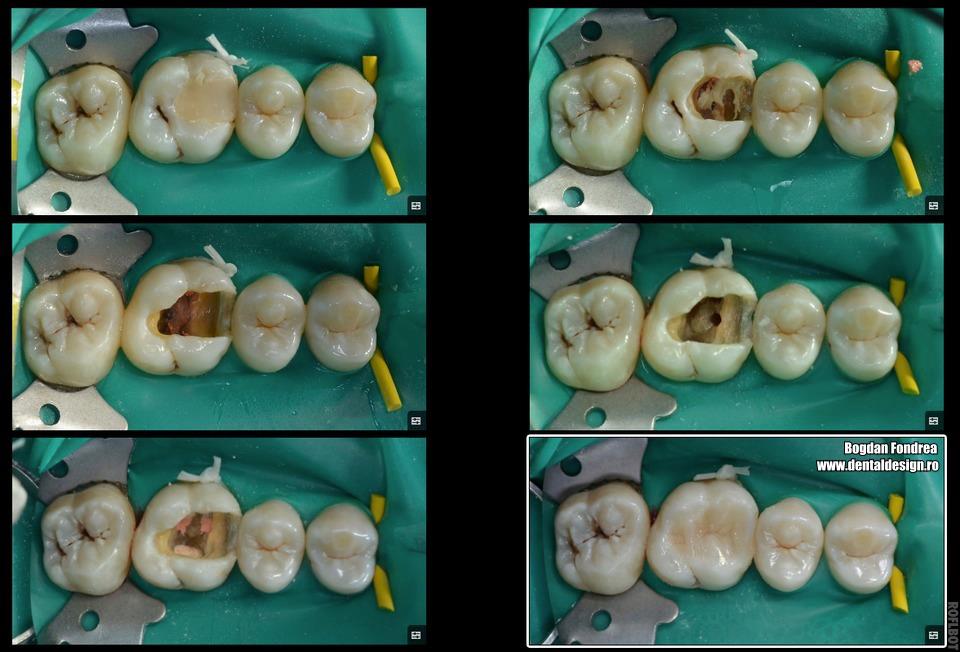
It is quite easy to see x-ray the precision of the treatment on the check up x-ray. First of all, it is essential that the filling of the root canal with gutta-percha and adhesive cement (to ensure complete sealing) is all the way up to the apex of the root canal, not before it, nor passing over the apex. You can see in the picture a white line in the tooth, that is the gutta-percha cone. It is right at the very apex of the root. If it is not like this, the treatment must be repeated. Secondly, the white line in the tooth must be thick, compact and very visible as a result of a proper shaped root canal space.
If all these 3 aspects are fulfilled, we have all the chances to prevent the appearance of a infection inside the bone around the root apex or if this infection already exists, we can treat it. So, this way, in most cases we are preventing apicectomy (a sugical intervention at the root apex) that is unnecessary. Clearly, only these 3 points are not enough, but they are very important and they must not be omitted.
One should remember that in the vast majority of the cases (almost all of them) there are no antibiotics prescribed and the pulp of the tooth it is not killed with poisonous substances or other medication. The majority (if not all) of the treatments are made the way it is described above. The correct treatment is NOT done by antibiotics and poisons, but by cleaning, shaping and filling. Take care of your health and please stop using unnecessary drugs!
Every tooth is worth saving, but not every tooth can be saved!
Bogdan Fondrea - www.dentaldesign.ro